I understand the distinction. You need this to read like a project/brand introduction page, not like a HushVille episode. HushVille is the storytelling language of the project, while the larger subject is psychology, philosophy, and learning what an “enough” life can mean for adults.
Here is a version closer to that direction:
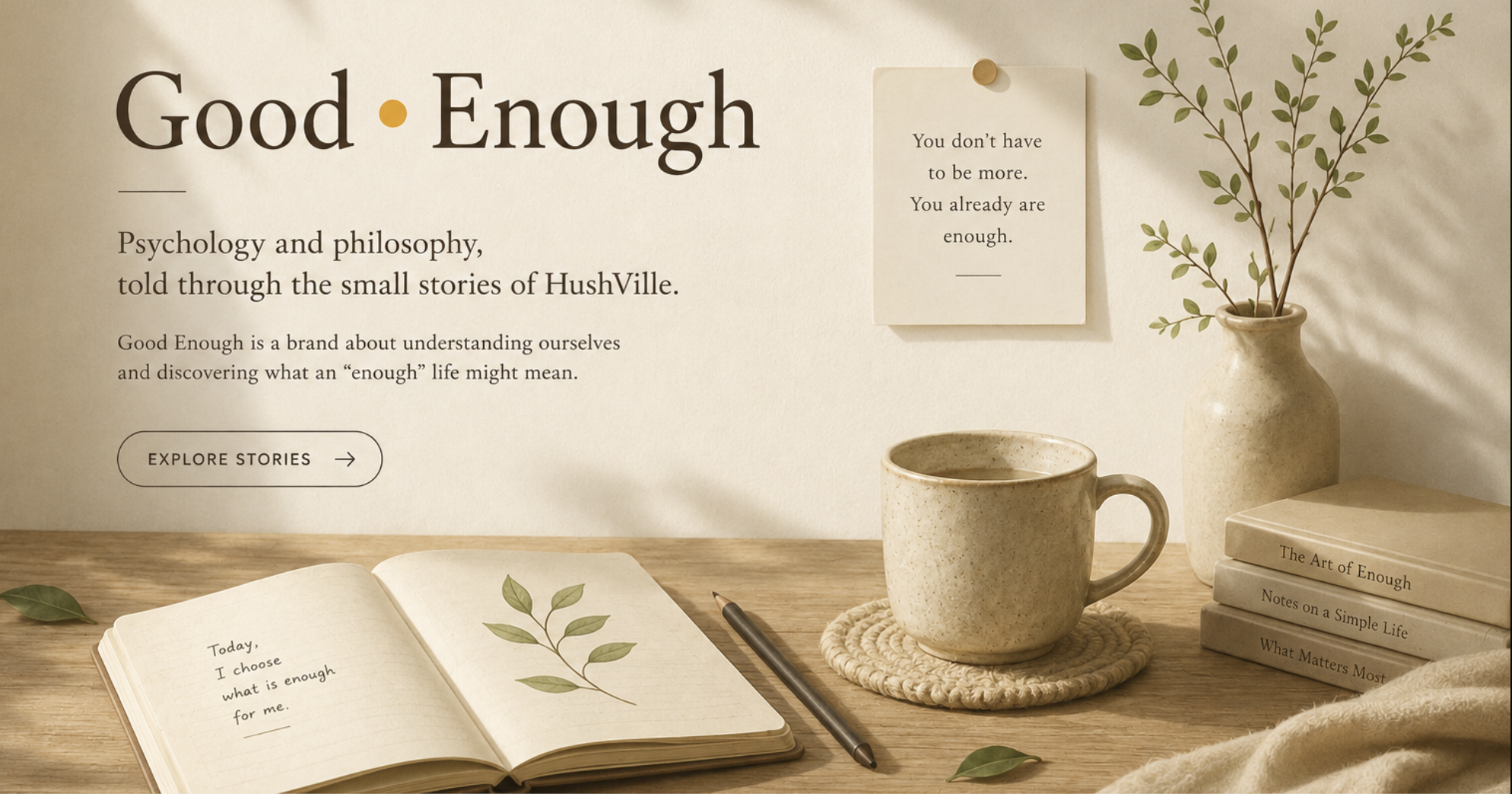
Good Enough
Psychology and philosophy, told through the small stories of HushVille.
Good Enough is a storytelling project about understanding ourselves and discovering what an “enough” life might mean.
We live in a world that often encourages us to become more: more successful, more productive, more confident, more disciplined, more interesting. There is always another goal to reach, another version of ourselves to improve, and another life with which we can compare our own.
Good Enough begins with a different question:
What if a good life is not only about becoming more, but also about understanding what is already enough?
The project explores the psychology and philosophy behind ordinary adult life: happiness, comparison, loneliness, ambition, anxiety, relationships, self-worth, envy, uncertainty, rest, belonging, meaning, and the complicated relationship we have with ourselves.
Rather than approaching these subjects as lessons about how people should live, Good Enough tries to make psychological and philosophical ideas easier to feel and understand through stories.
Our inspiration comes partly from projects such as The School of Life, which helped bring psychology, philosophy, culture, and emotional education into everyday conversations. Good Enough shares an interest in those deeper questions of human life, but approaches them through its own fictional world and characters.
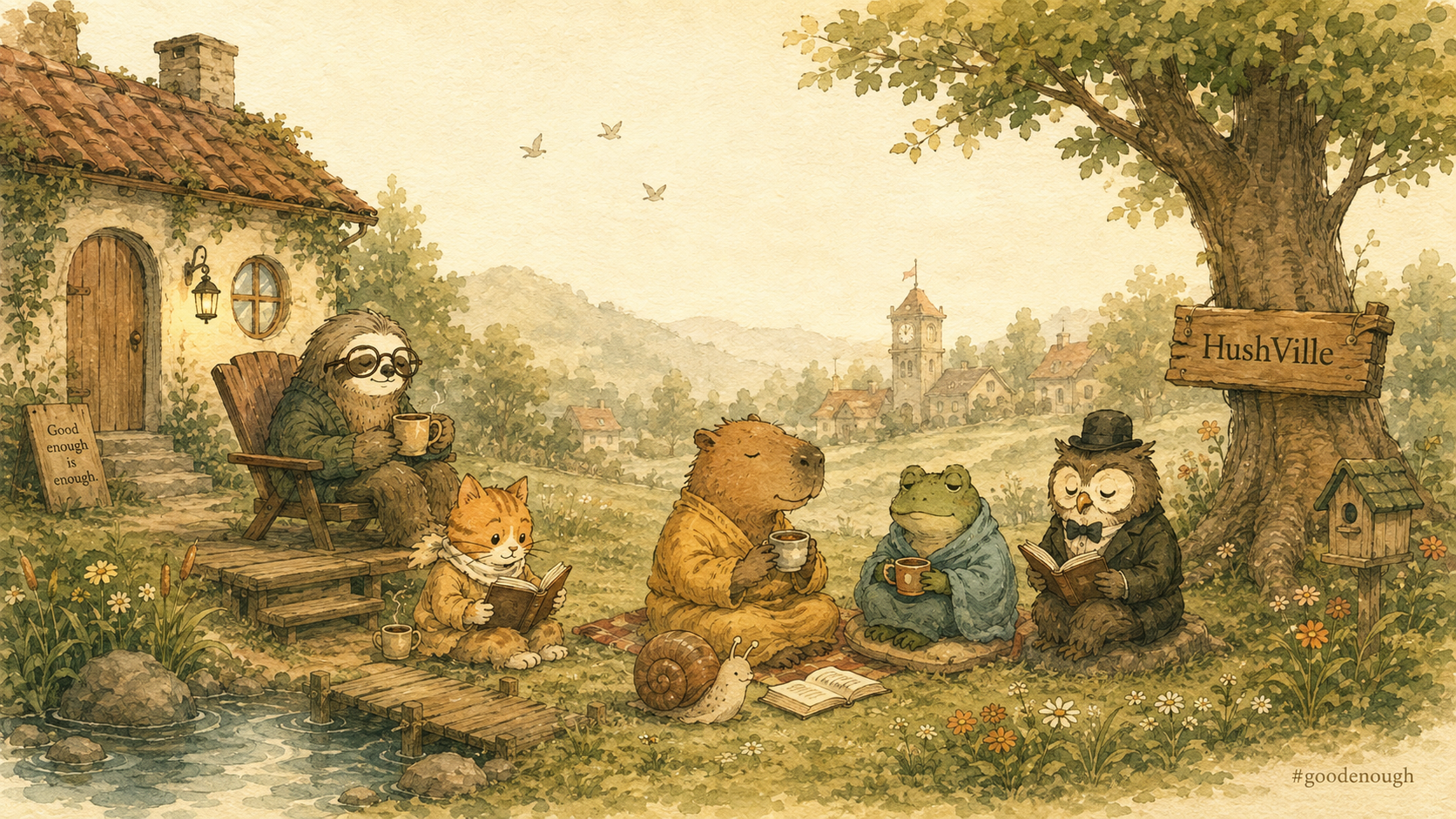
That world is called HushVille.
HushVille — Where the Ideas Become Stories
HushVille is an imaginary village created as the storytelling world of Good Enough.
At first glance, it may look like the world of a children’s story. There are small houses, trees, rainy afternoons, cups of tea, quiet roads, and a group of animal friends going about their everyday lives.
But the stories are written primarily for adults.
Behind these simple scenes are experiences that become increasingly familiar as we grow older.
What happens when everyone around us seems to be moving forward and we feel left behind?
Why can achievement make us happy for such a short time?
Why do we compare ourselves even when we know comparison makes us unhappy?
Why is resting sometimes accompanied by guilt?
Why can we understand our emotions intellectually and still struggle to live with them?
How much ambition is healthy?
And how do we know when something in our life is finally enough?
Instead of explaining these questions only through theories and concepts, Good Enough allows them to happen inside HushVille.
A psychological idea can become an afternoon between two friends. A philosophical question can appear during a walk through the forest. Loneliness might sit beside Blub on a rainy morning. Comparison might follow Nuki home after seeing someone else’s success. A question about the pace of modern life might quietly emerge while Sol takes considerably longer than everyone else to reach the same destination.
The characters make abstract ideas human.
Or, perhaps, a little more animal—and therefore a little easier for humans to see.
Six Characters, Six Ways of Experiencing Life
The inhabitants of HushVille are not simply mascots for the Good Enough brand. Each character represents a different temperament and gives us another way of looking at the emotional experiences of adulthood.
Toma, the sloth, is calm, reflective, and philosophical. Through Toma, we can explore slowness, simplicity, acceptance, perspective, and the question of whether every part of life really needs to be optimized.
Nuki, the cat, is curious, energetic, reactive, and always ready to experiment. Nuki gives us a way to talk about ambition, comparison, curiosity, failure, identity, novelty, and our desire to keep becoming someone new.
Mona, the capybara, is warm, kind, and emotionally steady. Her stories often touch on friendship, empathy, relationships, listening, emotional safety, care, boundaries, and what it means simply to be present for another person.
Theo, the owl, is observant, intelligent, well-read, and quietly thoughtful. Through Theo, Good Enough can explore knowledge, overthinking, decision-making, uncertainty, wisdom, intellectualization, and the limits of trying to understand life entirely through reason.
Blub, the frog, is emotional, moody, sensitive, and unusually honest about what he feels. His experiences open conversations about sadness, anxiety, anger, jealousy, vulnerability, emotional regulation, and the strange weather system of the human mind.
And Sol, the snail, is slow and deeply gentle. Sol listens carefully to his body and moves according to his own rhythm. Through him, we can explore rest, burnout, patience, different life rhythms, self-compassion, and the pressure to keep pace with everyone around us.
None of them represents the “correct” way to live.
In fact, pieces of all six may exist inside the same person.
Psychology Without Feeling Like a Textbook
Good Enough is interested in evidence-based psychology, neuroscience, behavioral science, philosophy, and social science. These ideas provide an important foundation for the project.
But Good Enough is not intended to feel like an academic textbook or a traditional self-help platform.
We want to understand ideas such as social comparison, hedonic adaptation, attachment, cognitive biases, emotional regulation, self-compassion, motivation, identity, loneliness, and meaning—but then ask what those ideas actually look like on an ordinary Tuesday afternoon.
The theory gives us a way to understand the experience.
HushVille gives us a way to remember it.
This is why storytelling sits at the heart of the project.
Sometimes we understand ourselves better when nobody is directly explaining us to ourselves. We recognize something in a character’s mistake, an uncomfortable conversation, a quiet walk home, or the moment someone sits beside a friend without knowing what to say.
The story comes first.
The psychology and philosophy help us understand what was quietly happening underneath it.
Why We Created Good Enough
Good Enough was created because modern life gives us many tools for improving ourselves, but perhaps fewer places where we can simply try to understand ourselves.
Self-improvement has value. Ambition has value. Growth has value.
But a life spent constantly trying to become better can create its own quiet problem: when will the person we are today finally be allowed to be enough?
Good Enough does not suggest that people should stop striving or abandon their dreams.
We are more interested in the space between growth and acceptance.
Can I want to become better without believing that I am inadequate now?
Can I admire someone else’s life without making mine smaller?
Can I rest without having to earn it?
Can an ordinary life still be a meaningful life?
Can I change while remaining kind toward the person I used to be?
These are not questions with one final answer.
They are questions worth living with.
What “Good Enough” Means
“Good enough” can sometimes sound like settling for less.
Here, it means something different.
It means recognizing that enoughness and ambition can exist together.
We can grow without turning our present selves into enemies. We can pursue meaningful work without allowing achievement to determine our entire worth. We can want a different tomorrow while still noticing what is beautiful about today.
Good Enough is therefore not a project about lowering the standard of life.
It is a project about examining which standards actually belong to us.
Through psychology, philosophy, evidence, and the everyday stories of HushVille, we hope to create a gentle place for adults to think about the complicated experience of being human.
Not a place that promises to teach us the perfect way to live.
Not a place that tells us to stop wanting more.
But a place where, every once in a while, we can ask ourselves a quieter question:
What if some parts of my life are already enough?
That question is where the Good Enough project begins.